In airports, shopping malls, retail chains, and other high-traffic commercial spaces, businesses need to maximize advertising exposure without consuming unnecessary floor space.
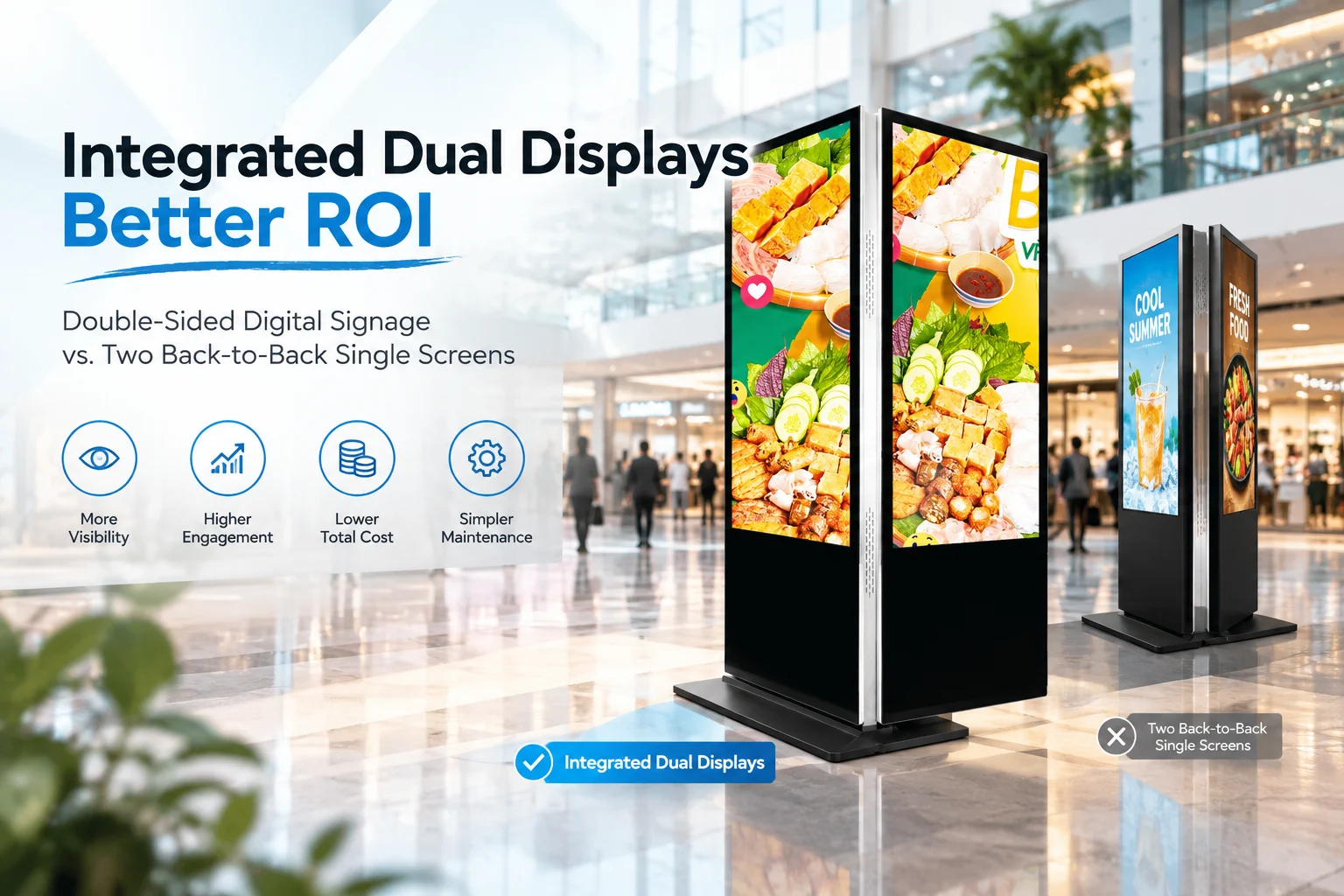
When content must be displayed in opposite directions, one common approach is to install two standard single-sided screens back-to-back. However, this configuration does not provide the same hardware architecture as a purpose-built double-sided digital signage system.
An integrated dual-sided display combines two screens within one engineered enclosure. It can share power, processing hardware, thermal management, and content management resources. For B2B buyers, these differences directly affect installation space, hardware costs, energy consumption, maintenance, and long-term operating efficiency.
1. Integrated Double-Sided Signage vs. Back-to-Back Screens
The main difference lies in how the two displays are engineered and managed.
| Evaluation Dimension | Integrated Double-Sided Digital Signage | Two Single-Sided Screens Back-to-Back |
|---|---|---|
| Physical Footprint | Ultra-slim single enclosure, using approximately 40%–50% less space | Larger dual-screen structure with separate mounting brackets |
| Power & Electronics | Shared power supply, mainboard, and dual-channel driving architecture | Duplicate power supplies, system boards, and cable connections |
| Hardware Cost | Approximately 20%–30% lower than purchasing two independent screens | Higher cost because two complete commercial displays are required |
| CMS Management | Single network node and cloud management license | Two independent network nodes and potentially two software licenses |
| Thermal Design | Central heat sink and optimized airflow channels | Rear panels can trap heat between the two displays |
| Content Control | Independent or synchronized content on both sides | Requires separate device management |
For commercial deployments, the integrated architecture reduces duplicated hardware while providing two viewing surfaces from a single physical installation.
2. How an Integrated Double-Sided Display Works
A purpose-built double-sided digital signage system typically combines two independent display panels with shared internal electronics.
Its architecture can include:
Front 4K Display → Shared Mainboard & Dual-Channel Driver → Rear 4K Display
The centralized system can also connect to a shared power module and cloud CMS network.
This configuration allows both sides to operate independently while sharing core hardware resources. Operators can therefore display different promotional campaigns on each side or synchronize the same content across both viewing directions.
3. Key Technical Advantages of Integrated Dual-Sided Displays
3.1 Shared Power and Processing Architecture
Two independent screens require duplicate power supplies, processing boards, and internal wiring.
An integrated dual-sided display can instead use a centralized power system, unified motherboard, and dual-channel driving circuits. According to the source specifications, this architecture can reduce hardware costs by approximately 20%–30%.
The shared architecture can also reduce redundant components and simplify internal cable routing.
For large retail or transportation networks, reducing duplicated components can simplify installation and long-term maintenance.
3.2 Smaller Installation Footprint
Space efficiency becomes increasingly important in airports, shopping centers, retail stores, and other commercial environments.
A dedicated double-sided display uses one slim enclosure rather than mounting two complete screens separately. The source specifications indicate that an integrated structure can occupy approximately 40%–50% less physical space than a comparable back-to-back configuration.
This makes the format suitable for:
- Airport corridors
- Shopping mall walkways
- Retail entrances
- Brand experience centers
- Exhibition spaces
- Commercial lobbies
The slimmer enclosure also creates a cleaner installation appearance where visual design is part of the customer experience.
3.3 Simplified CMS and Content Management
A double-sided digital signage system does not necessarily require operators to manage two independent hardware nodes.
With a unified CMS architecture, operators can control both displays from one centralized dashboard. The two sides can either:
- Play identical content simultaneously
- Display different content independently
- Run separate video campaigns
- Synchronize scheduled promotions
This reduces operational complexity when businesses manage multiple dual-sided displays across different commercial locations.
4. Thermal Management for 24/7 Commercial Operation
Thermal design is another important difference between an integrated dual-sided display and two screens mounted back-to-back.
When two conventional displays are installed with their rear panels facing each other, the enclosed space can restrict airflow and trap heat. Continuous heat exposure can contribute to LED backlight degradation and panel yellowing.
Purpose-built dual-sided displays use dedicated thermal structures instead. Depending on the design, these may include:
- Central heat-dissipation structures
- Optimized airflow channels
- Thermal vents
- Shared heat sinks
These features help maintain more stable operating temperatures during continuous commercial operation, including 24/7 applications.
5. Power Consumption and Operating Efficiency
Power consumption depends on screen size, brightness, display technology, content, and operating conditions. However, the integrated architecture can reduce duplicated electrical components.
The source specifications indicate that a double-sided display can achieve approximately 15%–25% lower total power consumption than two independent commercial displays.
For high-brightness installations operating for extended hours, this difference can contribute to lower ongoing energy costs.
Procurement teams should evaluate both rated power and actual operating power when comparing display configurations.
6. Independent Content on Both Sides
A common misconception is that a dual-sided display must show the same content on both panels.
Modern dual-sided commercial displays can use dual-channel display controllers to support independent content.
For example:
| Front Display | Rear Display |
|---|---|
| Brand advertisement | Product promotion |
| 4K promotional video | Retail campaign |
| Directional information | Event content |
| Seasonal campaign | Localized advertising |
This capability allows one physical installation to serve two different viewing directions and potentially support different audiences or advertising campaigns.
7. B2B Procurement Considerations
When selecting a double-sided digital signage solution, buyers should evaluate more than screen resolution.
Key specifications include:
- Display size and resolution — Determine whether 4K resolution is required for the viewing distance.
- Brightness — Match brightness to indoor, window-facing, or high-ambient-light environments.
- Thermal design — Confirm the cooling structure for continuous commercial operation.
- Power architecture — Compare rated consumption and expected operating consumption.
- CMS compatibility — Check whether one platform can control both display sides.
- Content independence — Confirm whether each panel can play separate content.
- Mounting configuration — Evaluate floor-standing or ceiling-suspended installation requirements.
- Maintenance access — Review how technicians access display and electronic components.
- Physical dimensions — Compare the complete enclosure footprint rather than panel size alone.
This approach helps procurement teams evaluate the total deployment cost rather than comparing two screens based only on initial purchase price.
8. Frequently Asked Questions
Can a double-sided digital signage display show different content on each side?
Yes. A dual-channel controller can allow the front and rear displays to run independent 4K videos, promotional graphics, or scheduled content. Both sides can also be synchronized when required.
Does a double-sided display use the same amount of power as two separate screens?
Not necessarily. The source specifications indicate that integrated dual-sided systems can reduce total power consumption by approximately 15%–25% through shared power conversion and processing architecture.
Actual consumption depends on display size, brightness, operating hours, and configuration.
Why is thermal management important for back-to-back displays?
Two separate screens can trap heat between their rear housings, particularly when airflow is restricted. A dedicated dual-sided enclosure can use central heat dissipation and optimized airflow channels to improve thermal management.
Is an integrated dual-sided display cheaper than buying two single-sided displays?
The source specifications indicate an approximately 20%–30% lower hardware cost for an integrated configuration compared with purchasing two separate screens. Actual project pricing depends on screen size, configuration, mounting system, and customization.